 Add to Chrome
 Add to Firefox
 Add to Edge
Statistics Approximation-Enabled Distributed Beamforming for Cell-Free Massive MIMO
Feb 03, 2026
We study a distributed beamforming approach for cell-free massive multiple-input multiple-output networks, referred to as Global Statistics \& Local Instantaneous information-based minimum mean-square error (GSLI-MMSE). The scenario with multi-antenna access points (APs) is considered over three different channel models: correlated Rician fading with fixed or random line-of-sight (LoS) phase-shifts, and correlated Rayleigh fading. With the aid of matrix inversion derivations, we can construct the conventional MMSE combining from the perspective of each AP, where global instantaneous information is involved. Then, for an arbitrary AP, we apply the statistics approximation methodology to approximate instantaneous terms related to other APs by channel statistics to construct the distributed combining scheme at each AP with local instantaneous information and global statistics. With the aid of uplink-downlink duality, we derive the respective GSLI-MMSE precoding schemes. Numerical results showcase that the proposed GSLI-MMSE scheme demonstrates performance comparable to the optimal centralized MMSE scheme, under the stable LoS conditions, e.g., with static users having Rician fading with a fixed LoS path.

Cell-Free MIMO in Space: Cooperative Satellite Transmission with Multi-Antenna Ground Users
Jan 27, 2026This paper develops a multi-user downlink communication framework for distributed low Earth orbit satellite networks serving ground users equipped with multiple antennas. Building upon the concept of cell-free multiple-input multiple-output in terrestrial networks, we propose a coordinated transmission scheme where multiple satellites jointly transmit spatially multiplexed data streams to each user. Using a new approximate achievable rate expression, we formulate a sum rate maximization problem under per-satellite and per-antenna power constraints and use the classical equivalence between sum rate maximization and mean square error minimization to optimize the satellites' precoding matrices using statistical channel state information. We numerically examine the performance of the proposed scheme in different settings and validate its effectiveness by comparing it against traditional precoding designs.
Maximum A Posteriori Probability Channel Tracking with an Intelligent Transmitting Surface
Jan 27, 2026This paper considers an intelligent transmitting surface (ITS) integrated into a base station and develops a low-overhead maximum a posteriori (MAP) probability channel tracking method for the dominant line-of-sight link between the ITS and the user equipment. We cast the per-block channel as a three-parameter model consisting of the channel amplitude, channel phase, and angle-of-arrival at the ITS. We exploit temporal correlation by updating the priors using the estimates from the previous block. Using only two pilots per coherence block alongside a targeted beam alignment strategy, the proposed method achieves precise channel tracking and attains spectral efficiency close to that achievable under perfect channel knowledge.
From Antenna Abundance to Antenna Intelligence in 6G Gigantic MIMO Systems
Jan 13, 2026Current cellular systems achieve high spectral efficiency through Massive MIMO, which leverages an abundance of antennas to create favorable propagation conditions for multiuser spatial multiplexing. Looking towards future networks, the extrapolation of this paradigm leads to systems with many hundreds of antennas per base station, raising concerns regarding hardware complexity, cost, and power consumption. This article suggests more intelligent array designs that reduce the need for excessive antenna numbers. We revisit classical uniform array design principles and explain how their uniform spatial sampling leads to unnecessary redundancies in practical deployment scenarios. By exploiting non-uniform sparse arrays with site-specific antenna placements -- based on either pre-optimized irregular arrays or real-time movable antennas -- we demonstrate how superior multiuser MIMO performance can be achieved with far fewer antennas. These principles are inspired by previous works on wireless localization. We explain and demonstrate numerically how these concepts can be adapted for communications to improve the average sum rate and similar metrics. The results suggest a paradigm shift for future antenna array design, where antenna intelligence replaces sheer antenna count. This opens new opportunities for efficient, adaptable, and sustainable Gigantic MIMO systems.
Joint Impact of ADC and Fronthaul Quantization in Cell-Free Massive MIMO-OFDM Uplink
Jan 10, 2026In the uplink of a cell-free massive MIMO system, quantization affects performance in two key domains: the time-domain distortion introduced by finite-resolution analog-to-digital converters (ADCs) at the access points (APs), and the fronthaul quantization of signals sent to the central processing unit (CPU). Although quantizing twice may seem redundant, the ADC quantization in orthogonal frequency-division duplex (OFDM) systems appears in the time domain, and one must then convert to the frequency domain, where quantization can be applied only to the signals at active subcarriers. This reduces fronthaul load and avoids unnecessary distortion, since the ADC output spans all OFDM samples while only a subset of subcarriers carries useful information. While both quantization effects have been extensively studied in narrowband systems, their joint impact in practical wideband OFDM-based cell-free massive MIMO remains largely unexplored. This paper addresses the gap by modeling the joint distortion and proposing a fronthaul strategy in which each AP processes the received signal to reduce quantization artifacts before transmission. We develop an efficient estimation algorithm that reconstructs the unquantized time-domain signal prior to fronthaul transmission and evaluate its effectiveness. The proposed design offers new insights for implementing efficient, quantization-aware uplink transmission in wideband cell-free architectures.
Cell-Free Massive MIMO with Hardware-Impaired Wireless Fronthaul
Jan 10, 2026Cell-free massive MIMO (multiple-input multiple-output) enhances spectral and energy efficiency compared to conventional cellular networks by enabling joint transmission and reception across a large number of distributed access points (APs). Since these APs are envisioned to be low-cost and densely deployed, hardware impairments, stemming from non-ideal radio-frequency (RF) chains, are unavoidable. While existing studies primarily address hardware impairments on the access side, the impact of hardware impairments on the wireless fronthaul link has remained largely unexplored. In this work, we fill this important gap by introducing a novel amplify-and-forward (AF) based wireless fronthauling scheme tailored for cell-free massive MIMO. Focusing on the uplink, we develop an analytical framework that jointly models the hardware impairments at both the APs and the fronthaul transceivers, derives the resulting end-to-end distorted signal expression, and quantifies the individual contribution of each impairment to the spectral efficiency. Furthermore, we design distortion-aware linear combiners that optimally mitigate these effects. Numerical results demonstrate significant performance gains from distortion-aware processing and illustrate the potential of the proposed AF fronthauling scheme as a cost-effective enabler for future cell-free architectures.
Feasibility Study Regarding Self-sustainable Reconfigurable Intelligent Surfaces
Jan 08, 2026Without requiring operational costs such as cabling and powering while maintaining reconfigurable phase-shift capability, self-sustainable reconfigurable intelligent surfaces (ssRISs) can be deployed in locations inaccessible to conventional relays or base stations, offering a novel approach to enhance wireless coverage. This study assesses the feasibility of ssRIS deployment by analyzing two harvest-and-reflect (HaR) schemes: element-splitting (ES) and time-splitting (TS). We examine how element requirements scale with key system parameters, transmit power, data rate demands, and outage constraints under both line-of-sight (LOS) and non-line-of-sight (NLOS) ssRIS-to-user equipment (UE) channels. Analytical and numerical results reveal distinct feasibility characteristics. The TS scheme demonstrates better channel hardening gain, maintaining stable element requirements across varying outage margins, making it advantageous for indoor deployments with favorable harvesting conditions and moderate data rates. However, TS exhibits an element requirement that exponentially scales to harvesting difficulty and data rate. Conversely, the ES scheme shows only linear growth with harvesting difficulty, providing better feasibility under challenging outdoor scenarios. These findings establish that TS excels in benign environments, prioritizing reliability, while ES is preferable for demanding conditions requiring operational robustness.
On the Impact of Channel Aging and Doppler-Affected Clutter on OFDM ISAC Systems
Jan 08, 2026The temporal evolution of the propagation environment plays a central role in integrated sensing and communication (ISAC) systems. A slow-time evolution manifests as channel aging in communication links, while a fast-time one is associated with structured clutter with non-zero Doppler. Nevertheless, the joint impact of these two phenomena on ISAC performance has been largely overlooked. This addresses this research gap in a network utilizing orthogonal frequency division multiplexing waveforms. Here, a base station simultaneously serves multiple user equipment (UE) devices and performs monostatic sensing. Channel aging is captured through an autoregressive model with exponential correlation decay. In contrast, clutter is modeled as a collection of uncorrelated, coherent patches with non-zero Doppler, resulting in a Kronecker-separable covariance structure. We propose an aging-aware channel estimator that uses prior pilot observations to estimate the time-varying UE channels, characterized by a non-isotropic multipath fading structure. The clutter's structure enables a novel low-complexity sensing pipeline: clutter statistics are estimated from raw data and subsequently used to suppress the clutter's action, after which target parameters are extracted through range-angle and range-velocity maps. We evaluate the influence of frame length and pilot history on channel estimation accuracy and demonstrate substantial performance gains over block fading in low-to-moderate mobility regimes. The sensing pipeline is implemented in a clutter-dominated environment, demonstrating that effective clutter suppression can be achieved under practical configurations. Furthermore, our results show that dedicated sensing streams are required, as communication beams provide insufficient range resolution.
Flexible Continuous Aperture Arrays
Nov 12, 2025A novel electromagnetic (EM) structure termed flexible continuous aperture array (FCAPA) is proposed, which incorporates inherent surface flexibility into typical continuous aperture array (CAPA) systems, thereby enhancing the degrees-of-freedom (DoF) of multiple-input multiple-output (MIMO) systems equipped with this technology. By formulating and solving a downlink multi-user beamforming optimization problem to maximize the weighted sum rate (WSR) of the multiple users with FCAPA, it is shown that the proposed structure outperforms typical CAPA systems by a wide margin, with performance increasing with increasing morphability.
Experimental Validation of Reflective Near-Field Beamfocusing using a b-bit RIS
Nov 10, 2025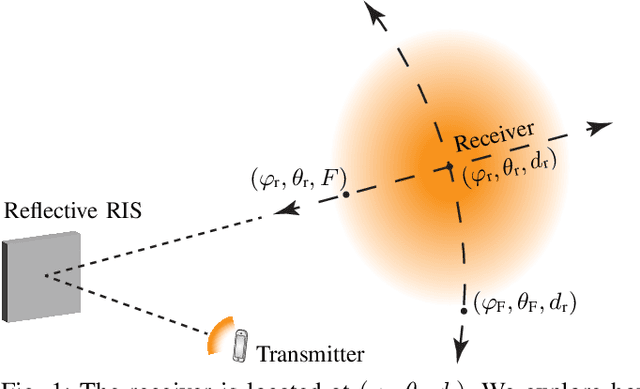
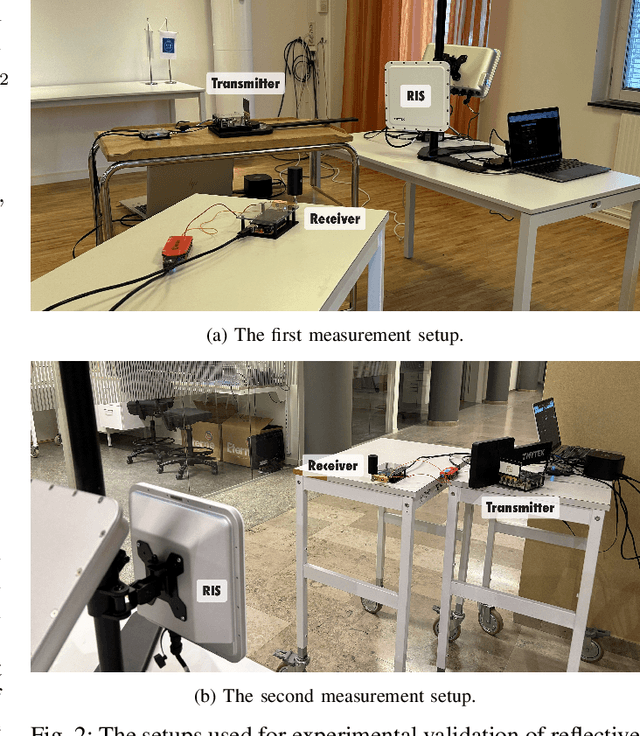
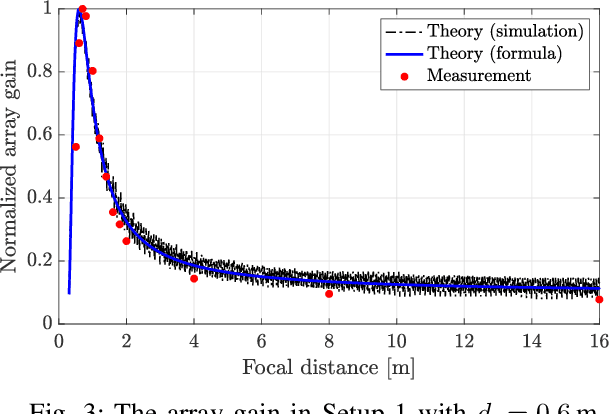
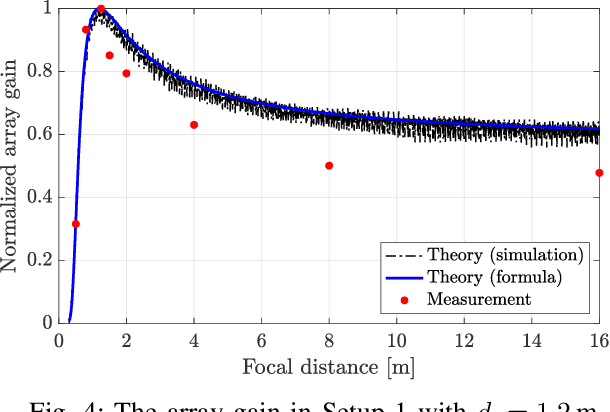
This paper presents the first experimental validation of reflective near-field beamfocusing using a reconfigurable intelligent surface (RIS). While beamfocusing has been theoretically established as a key feature of large-aperture RISs, its practical realization has remained unexplored. We derive new analytical expressions for the array gain achieved with a $b$-bit RIS in near-field line-of-sight scenarios, characterizing both the finite depth and angular width of the focal region. The theoretical results are validated through a series of measurements in an indoor office environment at 28 GHz using a one-bit 1024-element RIS. The experiments confirm that near-field beamfocusing can be dynamically achieved and accurately predicted by the proposed analytical model, despite the presence of hardware imperfections and multipath propagation. These findings demonstrate that near-field beamfocusing is a robust and practically viable feature of RIS-assisted wireless communications.